TLDR: Build the kit around four customer actions
The most effective local service marketing materials for car washes are not a giant bundle of matching print products. They are a small, coordinated set of materials that helps people take four actions: try the wash, understand the membership, return later, and participate in a legitimate community offer.
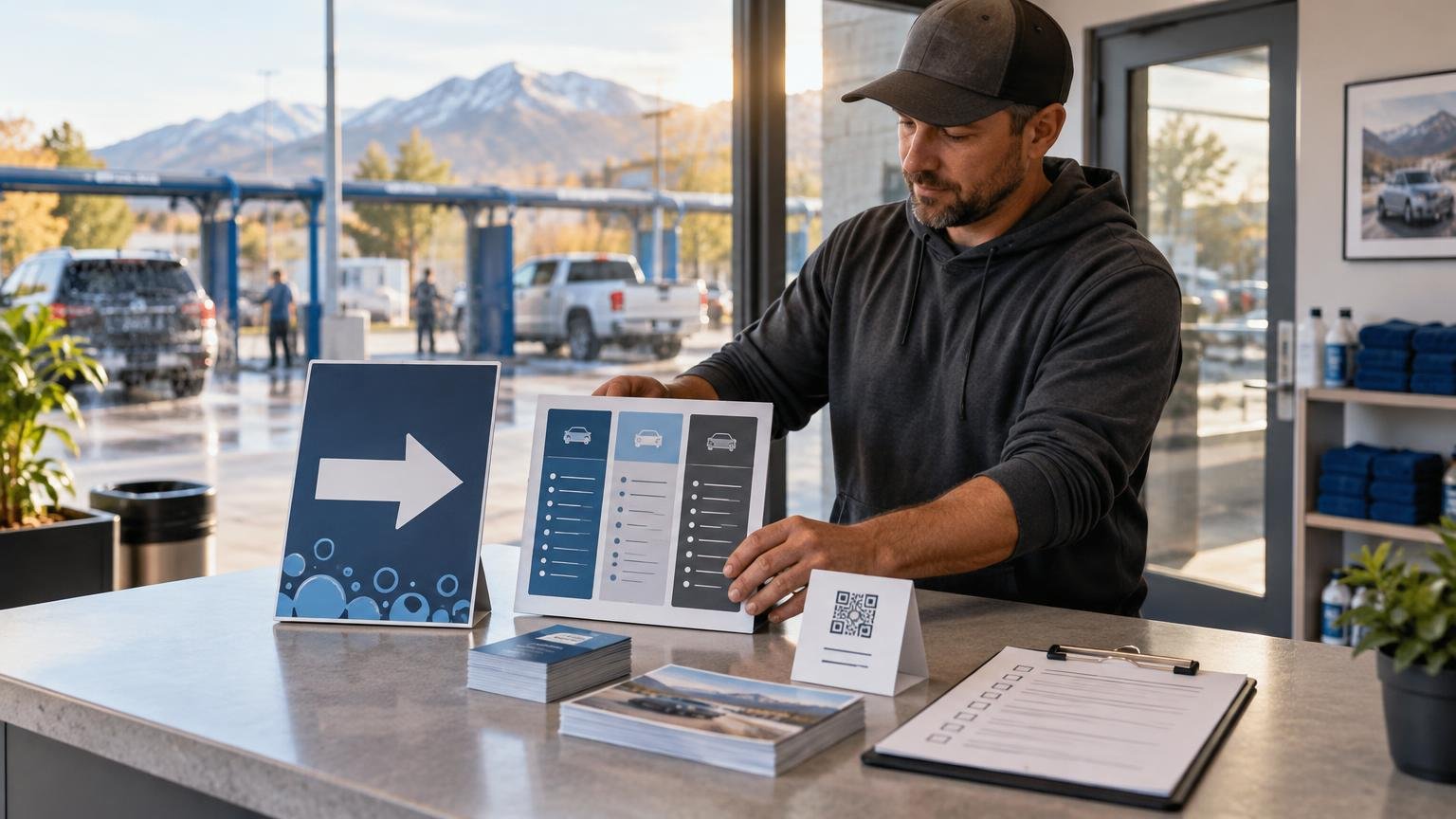
For a typical Utah location, start with five items: a clear roadside or entrance sign, an easy-to-compare menu board, a membership card or handout, a neighborhood postcard, and a neutral review-request card or sign. Give every campaign its own code, QR destination, or landing page so you can tell which materials create visits rather than merely looking polished.
Choose an objective before choosing a format
A postcard, counter card, vacuum-area sign, and fundraiser flyer should not repeat the same generic message. Each occupies a different point in the customer journey. Decide what the customer should do next, then choose the format and placement that make that action easy.
- New-customer trial: Give a nearby household a clear reason to make its first visit.
- Membership conversion: Help a customer compare a recurring plan with one-time wash options.
- Repeat visits: Remind an existing customer to return, renew, redeem a valid offer, or use an included benefit.
- Community participation: Explain a real fundraiser, event, or business partnership without turning it into vague local-support language.
The operating format changes the mix. An express tunnel may emphasize lane-entry signs, menu clarity, and membership conversion. A self-serve wash may need equipment labels, bay instructions, and repeat-visit offers. A mobile detailer relies more heavily on appointment cards, neighborhood leave-behinds, and referral materials. Build for the way customers actually encounter the business.
The first five materials to prioritize
1. Roadside or entrance message
The entrance message has one job: help a driver understand the offer before reaching the decision point. Use a short headline, one meaningful price or benefit when applicable, and a visible directional cue. Avoid listing every wash feature on a sign intended to be read from a moving vehicle.
2. Service and membership comparison board
A menu board should make differences obvious. Group comparable services, use consistent terminology, and explain what the membership includes. If cancellation rules, vehicle limits, introductory pricing, or automatic renewal materially affect the offer, place those terms where customers can see them before enrolling.
3. Membership leave-behind
A small card gives customers time to consider the plan without holding up a lane. Include the recurring price, included services, enrollment method, important eligibility terms, and a direct URL or mobile-ready QR code. The card should answer the practical question: “What do I receive, and what am I agreeing to?”
4. Neighborhood postcard
A postcard can introduce the wash to households within a realistic driving radius. Lead with one offer or reason to visit, not a complete service catalog. Include the street address, useful landmark or map cue, operating hours, expiration date where applicable, and a code unique to the mailing area.
USPS says Every Door Direct Mail allows businesses to select mailing routes and use demographic filters. That can make the USPS Every Door Direct Mail tool useful when a wash wants broad household coverage in nearby carrier routes rather than a named mailing list. Current rates, size rules, route limits, and preparation requirements should be checked before committing to a campaign.
5. Review-request prompt
Place a small prompt on a receipt, counter card, exit sign, or follow-up message. Google Business Profile supports creating a review link or QR code and identifies receipts and in-store displays among the places where businesses can use it. The wording should invite an honest review or feedback, not demand a five-star rating.
Match each material to its job
| Material | Primary job | Essential copy | Simple tracking method |
|---|---|---|---|
| Entrance sign | Turn passing awareness into a visit | One offer or benefit, direction, key limit | Short campaign code |
| Menu board | Improve service and membership decisions | Options, included features, prices, material terms | Point-of-sale selection data |
| Membership card | Support enrollment after the conversation | Recurring terms, benefits, URL or QR destination | Dedicated enrollment page |
| Neighborhood postcard | Generate first visits from nearby households | Offer, location, hours, expiration and restrictions | Route- or area-specific code |
| Partnership card | Connect customers from a nearby organization | Partner-specific benefit and valid dates | Unique partner code |
| Fundraiser sheet | Explain how participation benefits the organization | Dates, eligible purchases, redemption process and contact | Fundraiser identifier |
| Review prompt | Invite honest customer feedback | Neutral request and direct review link | Review-link visits, not promised ratings |
| Service-recovery card | Give staff a controlled response to a documented problem | Remedy, limits, expiration and manager contact | Single-use code |
Tracking does not need to be complicated. A single-location operator can use distinct point-of-sale codes such as POSTCARD, VACUUM, PARTNER, and RECOVERY. QR codes can lead to campaign-specific pages, but the printed destination should also appear in readable text. That gives customers an alternative if the code fails and makes the destination easier to verify.
Build a neighborhood and community kit
Local distribution works best when it reflects the wash’s actual service area. Start with neighborhoods that have a convenient driving route to the location. A large mailing footprint can waste money if the wash sits across a difficult interchange or far outside a household’s normal errands.
For nearby businesses, create a partnership card with a specific and administratively simple arrangement. State who qualifies, what the customer receives, when it applies, and how the partner is identified. Do not place another organization’s name or logo on a piece until its use has been approved.
A school, team, or nonprofit fundraiser needs more than a logo beside the car wash’s regular advertisement. The one-sheet should explain the participation period, eligible purchase, amount or method of support, redemption instructions, point of contact, and any limit. Confirm the organization’s current fundraising and brand-use rules before printing.
Community-event materials can stay modest: a table sign, offer card, staff reference sheet, and practical giveaway are often enough. Weather-exposed decals make sense for vacuum instructions, equipment reminders, bay labels, or an event handout intended for outdoor use. When that use case is appropriate, compare artwork requirements and intended surfaces before ordering custom stickers for outdoor-facing reminders or giveaways. The supplier describes its waterproof line as vinyl with a waterproof laminate intended for outdoor use, but that first-party specification does not establish performance on every surface or under every wash chemical and pressure condition. New buyers can also use this first-time sticker ordering guide to check artwork, proofing, size, and material choices.
Write every offer so the customer can understand it
A strong promotional piece answers the important questions without forcing the customer to reach the register for the real terms. Federal Trade Commission guidance says material terms and conditions for promotions described as free or low-cost with a purchase should be clear and conspicuous.
- State the offer in one sentence.
- Identify the participating location if the business has more than one.
- Show the valid dates or expiration date.
- Explain whether the offer is for new customers, one vehicle, one household, or another defined group.
- Name the eligible wash package or membership tier.
- Disclose required purchases, recurring charges, automatic renewal, or other material conditions.
- List meaningful exclusions, including days, vehicle types, or combinations with other discounts when applicable.
- Provide a readable redemption method and customer-contact path.
“First wash free” needs enough context to prevent surprises. Does it require membership enrollment? Is the membership billed immediately or after an introductory period? Is the offer limited to a specific package, vehicle, or location? Similarly, a low introductory membership price should not visually overpower a recurring price or condition that materially changes the deal.
Keep review requests separate from rewards
A car wash can ask customers for honest feedback and provide a convenient review link. It should not offer a free wash, discount, giveaway entry, or other reward in exchange for a positive Google review. Google prohibits incentives in exchange for reviews, while FTC guidance addresses deceptive review and testimonial practices.
The clean approach is to separate the activities. A loyalty offer can reward a repeat visit under its stated terms. A review prompt can independently say, “Tell us about your experience,” and link directly to the review form. Staff should ask consistently rather than selecting only customers who appear likely to leave high ratings.
Service-recovery cards also deserve a separate workflow. If a wash fails or equipment causes a documented problem, give staff a clearly limited remedy code and a way to escalate the issue. Do not condition that remedy on changing, deleting, or withholding a review.
Localize the materials for Utah customers
Utah is not one uniform market. A wash near a dense Wasatch Front commuter route faces a different customer pattern from one serving a smaller town, a recreation corridor, or a fast-growing suburban area. Localize the distribution radius, landmark directions, seasonal message, and community partnerships instead of relying on generic “Utah-owned” imagery to do all the work.
Language choices should follow the audience around the individual location. Census QuickFacts reports that 15.9% of Utah residents age five and older spoke a language other than English at home during 2020–2024. That statewide figure does not mean every piece needs translation. It is a reason to examine local customer needs and, when justified, have important offer terms and instructions translated and reviewed by a competent speaker.
Seasonal references should also be operationally honest. A winter campaign can emphasize convenient removal of ordinary road grime only if the relevant wash package and equipment are available. An event or recreation-themed promotion should not imply an official partnership that has not been approved.
A practical 30-day rollout
Do not launch twelve new pieces at once. A controlled first month makes it easier to identify what works and correct confusing copy before a larger print run.
- Choose one acquisition item: a postcard, nearby-business card, or tightly targeted event handout.
- Choose one on-site conversion item: usually a simpler menu board, membership card, or vacuum-area reminder.
- Choose one retention item: a renewal reminder, referral card, or service-recovery card with controlled terms.
- Choose one community item tied to an approved and specific partnership or fundraiser.
- Assign a unique code, phone extension, short URL, or landing destination to every campaign.
- Train staff on the exact offer, eligibility rules, redemption steps, and escalation path.
- Record redemptions, membership enrollments, customer questions, and distribution cost for 30 days.
- Revise the message or placement before increasing quantity. Keep a control version so changes can be compared.
Measure the action each piece was designed to produce. A postcard should be judged by attributable visits or purchases, not QR scans alone. A membership card should be evaluated by completed enrollments and customer questions. A fundraiser sheet should be judged by valid participation and whether the organization could administer it without confusion.
The same campaign discipline applies across neighborhood service businesses. Pure Utah’s guide to local-service marketing materials for lawn care businesses offers a useful parallel for route targeting, clear offers, and print tracking, even though a car wash has different on-site conversion points.
Start small, make the offer clear, and track the result
The right car-wash marketing kit is the one customers can understand and staff can administer. Begin with a visible entrance message, a clear comparison board, a useful membership handout, one targeted neighborhood piece, and a neutral review prompt. Add fundraiser sheets, partnership cards, decals, and event materials only when each has a defined job.
Before printing, read every piece from the customer’s perspective: What is being offered? Who qualifies? When does it end? What happens next? Then assign a unique tracking method. That final step turns local marketing materials from a collection of branded objects into a system a Utah car-wash operator can improve.
References
- Every Door Direct Mail (EDDM) – Targeted Mail Marketing | USPS
- Create a Google link or QR code to request reviews – Google Business Profile Help
- Waterproof Stickers | Durable Custom Stickers – CustomStickers.com
- Advertising FAQ's: A Guide for Small Business | Federal Trade Commission
- www.ftc.gov
- U.S. Census Bureau QuickFacts: Utah