
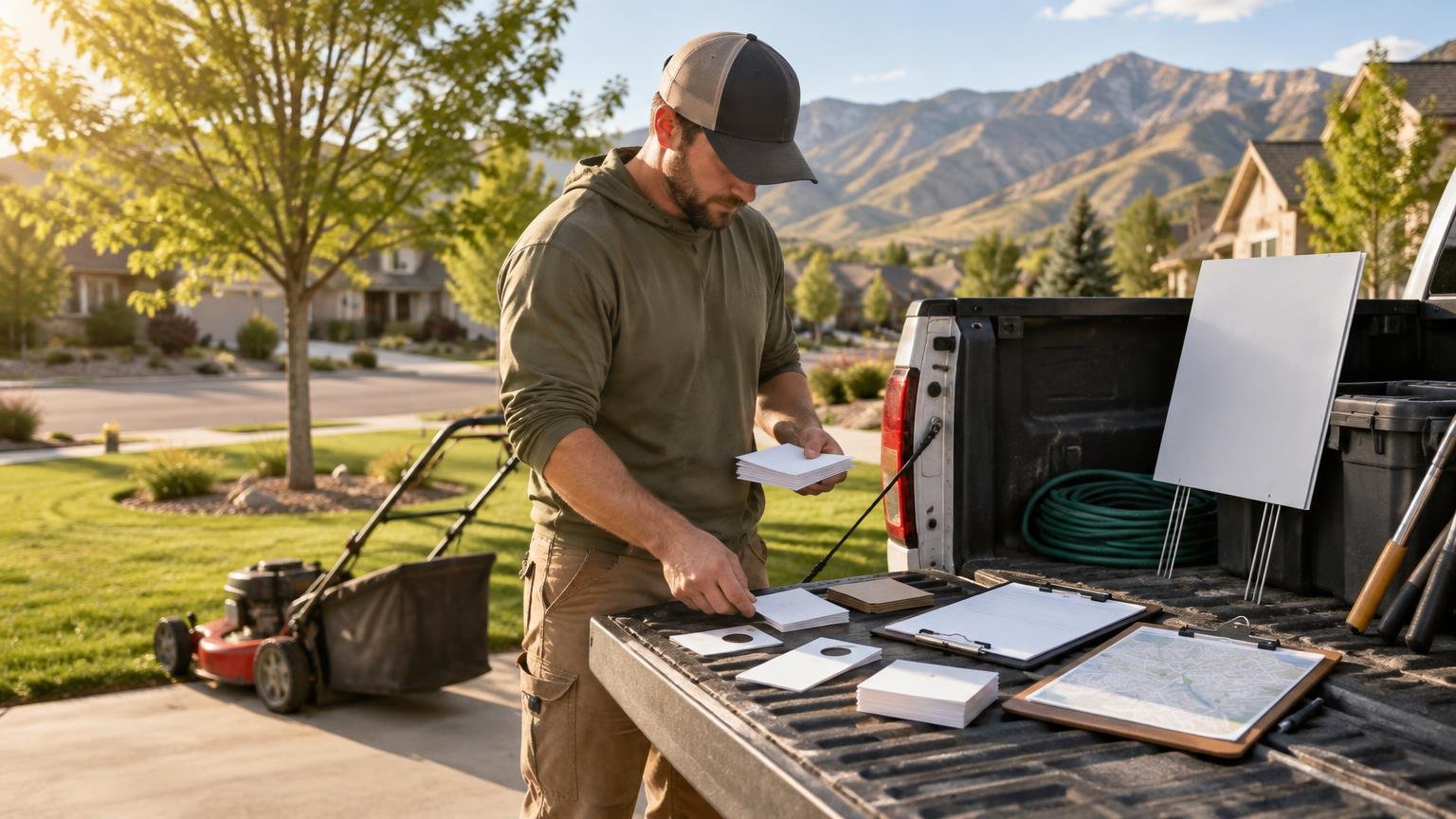
TLDR: The best local service marketing materials for lawn care businesses form a small, reusable kit: one neighborhood postcard or flyer, a focused door hanger, a professional estimate sheet, customer referral and review cards, and clear vehicle or equipment identification. Add lawn signs only with customer permission. Change the offer by season, keep water and environmental claims specific, and track every piece by neighborhood and campaign.
For a Utah operator, local service marketing materials for lawn care businesses should help build tighter routes rather than merely generate scattered leads. A customer three streets from an existing stop may be more useful than an equally valuable job requiring a long drive across the valley. Your printed materials should therefore answer three questions quickly: what do you do, where do you work, and what should the homeowner do next?
You do not need a thick catalog or six versions of every flyer. Begin with a minimum viable print kit tied to the moments when nearby homeowners are most likely to notice and trust your company.
Start with materials that match the service moment
Each printed piece has a different job. A postcard can introduce a company across a selected area, while a door hanger works at the block level. A lawn sign benefits from visible completed work, and an estimate sheet helps convert someone who has already shown interest. Choosing by deployment moment keeps the kit useful and prevents one overcrowded flyer from trying to do everything.
New route or neighborhood: a postcard or flyer
Use a postcard or flyer when you want to introduce a service to a defined area. Lead with one timely offer, not an inventory of every task your crew could possibly perform. “Spring cleanup and first mow scheduling in South Jordan” is clearer than a long list mixing cleanup, fertilization, irrigation, snow removal, and landscape construction.
Include the service area, a phone number, a short web address or QR code, and any material offer conditions. Give the campaign a unique code so you can compare neighborhoods. If two routes receive different codes, incoming calls and form submissions can reveal which area produced useful leads rather than merely more inquiries.
Working nearby: a narrow, respectful door hanger
A door hanger makes sense when a crew is already working on a block and can realistically accept another nearby customer. Keep it restrained: one service, one reason the timing matters, and one response method. Say “We are scheduled on this street Thursday” only when that statement is true. Do not imply that a neighbor is a customer, identify a customer, or use a property photograph without permission.
Before distribution, check city rules, posted no-soliciting requests, community policies, and HOA restrictions. Door hangers are not an invitation to enter fenced areas, open mailboxes, or place material where the property owner has clearly declined solicitation.
Visible completed work: a customer-permitted lawn sign
A lawn sign can connect visible work with a business name, especially after cleanup, edging, sod work, or a landscape refresh. Ask the customer first and agree on placement and removal timing. The design should work from the street: business name, primary service, and a large phone number or memorable address. Tiny service lists and multiple badges usually become visual noise.
In-person estimates: a practical leave-behind
An estimate folder or one-page leave-behind should make the next step unambiguous. State the proposed scope, frequency, price basis, exclusions, expiration date, and acceptance method. If disposal, materials, sprinkler repairs, steep lots, locked gates, or pet-waste conditions can change the price, explain that before work begins.
This document is part sales tool and part expectation-setting tool. A polished estimate that leaves the scope vague can create more trouble than a simple sheet that clearly distinguishes weekly mowing from cleanup, edging, irrigation work, or pesticide treatment.
Recurring customers: referral and review cards
Referral cards work best when the request is easy to understand. Explain who qualifies, what the reward is, when it is earned, and whether there is an expiration date. Review cards should point to the correct listing with a short URL or QR code, but the request should seek an honest review rather than dictate what the customer should say.
Everyday visibility: vehicles and equipment
A service vehicle can provide repeated identification along an existing route. At minimum, make the company name, core service, and contact method readable without requiring someone to study the design. Operators considering a larger treatment can review what makes a vehicle wrap look professional and how Utah conditions affect vehicle wraps before choosing a design and maintenance plan.
Equipment identification serves a different purpose. Small mower, trailer, bin, and tool labels can show ownership and keep a consistent company identity across a crew. Operators assembling this part of the kit can consider custom stickers for equipment labels and customer leave-behinds while choosing sizes and formats appropriate to the intended use.
What every lawn-care marketing piece should say
A homeowner should not have to decode the offer. Most pieces need the following information, adjusted to fit the format:
- Company name and a short description of the primary service.
- Actual service area, expressed as cities, neighborhoods, ZIP codes, or route boundaries that the company can reliably cover.
- A direct next step, such as calling, texting, requesting an estimate, or booking an evaluation.
- A phone number plus one backup response method, such as a web form or QR code.
- Offer conditions, including dates, minimum service, property limitations, or new-customer restrictions.
- Relevant credentials or license information only when it applies to the advertised work.
- A campaign or neighborhood code that makes response tracking possible.
Match proof to the promise. If a piece says “licensed for pesticide applications,” confirm that the business and individual workers hold the applicable credentials. If the company only mows, edges, and cleans properties, do not use pesticide licensing language to make routine maintenance appear regulated or specialized.
Testimonials, before-and-after photographs, and neighborhood references also require care. Obtain permission, preserve the meaning of the customer’s words, and avoid suggesting that an entire HOA or neighborhood endorses the company because one resident hired it.
A Utah seasonal print calendar
Utah’s elevation and regional climate differences make one statewide promotional calendar impractical. Southern Utah and higher-elevation communities do not enter the growing season at the same time. Treat this as a planning sequence, then adjust deployment to local conditions and the services you actually provide.
| Service moment | Best-fit material | Useful message | Primary action |
|---|---|---|---|
| Early spring cleanup | Postcard or route flyer | Cleanup, debris removal, bed preparation, and first-visit scheduling | Request an estimate |
| Active mowing season | Door hanger or referral card | A nearby recurring route has limited scheduling capacity | Call or text for availability |
| Irrigation checks and summer stress | Targeted flyer or customer insert | Inspection or adjustment based on current property conditions | Book an evaluation |
| Late-season aeration or cleanup | Postcard, email companion, or estimate insert | Service window, scope, and booking deadline | Reserve a service date |
| Off-season planning | Customer card or estimate follow-up | Priority scheduling or route renewal for the next service season | Confirm or update service |
Print in manageable batches. A seasonal piece becomes expensive clutter when the weather changes, the route fills, or an offer expires while hundreds remain in a box. A smaller first run also gives you room to improve the headline and response process based on actual calls.
Keep water, pesticide, and environmental claims specific
Utah lawn watering guidance is localized and weather-sensitive. Conserve Water Utah publishes a weekly guide rather than one permanent schedule for the entire state. Marketing should therefore direct customers to current local guidance or describe an inspection-based service instead of promising one fixed statewide watering routine.
A useful message might offer an irrigation check, controller review, or property-specific recommendation. Avoid implying that a flyer’s generic schedule overrides local restrictions, site conditions, plant needs, or current public guidance.
Pesticide-related work is another important dividing line. Utah uses distinct categories for commercial pesticide businesses, commercial applicators, and ornamental and turf technicians. Those requirements should not be conflated with ordinary mowing, edging, or debris cleanup. A company advertising herbicide, insecticide, or other regulated applications should verify which business and worker credentials apply to the offered service.
Environmental language must also be supportable. Broad phrases such as “eco-friendly,” “non-toxic,” “chemical-free,” or “safe for everything” can communicate much more than a company has evidence to prove. The FTC’s environmental marketing guidance cautions against broad, unqualified environmental-benefit claims and calls for substantiation.
Prefer a narrow statement that can be documented. For example, describe the specific practice—such as providing an irrigation inspection before recommending a controller adjustment—rather than turning it into an unsupported promise to “save water.” If savings are quantified, retain the basis, assumptions, and conditions behind the figure.
When a postcard is better than a door hanger or sign
Choose a postcard when you need planned geographic coverage and can handle responses from a broader area. Choose a door hanger when the opportunity is tightly connected to a real nearby route. Choose a lawn sign when the completed work is visible and the customer has agreed to placement.
- Use postcards to test a neighborhood, announce a seasonal booking window, or expand around an established route.
- Use door hangers for a small number of nearby properties when the crew is genuinely scheduled in the immediate area.
- Use lawn signs when the work itself provides useful context and permission is documented.
- Use estimate sheets after contact, when scope and expectations matter more than broad awareness.
- Use referral cards with satisfied customers who already understand the service.
The formats can support one another without repeating identical copy. A postcard can create awareness, a door hanger can show that the route is now active nearby, and the estimate sheet can convert interest into a defined service agreement.
Using EDDM for neighborhood distribution
USPS presents Every Door Direct Mail as a way to select local delivery routes and send qualifying mailpieces without maintaining a conventional household address list. That can fit a lawn-care company interested in geographic route density rather than individual recipient targeting.
EDDM is a distribution option, not a guarantee that the selected route matches your ideal customer or crew capacity. Before printing, inspect the current route-selection information and verify USPS eligibility, dimensions, postage, quantity limits, preparation, bundling, facing-slip, and entry requirements. These details and rates can change.
Estimate the operational consequence as well as the mailing cost. If a campaign succeeds, can the business quote and service that route without disrupting current customers? A narrowly chosen route with a clear seasonal offer may be more useful than wider coverage that produces inefficient travel.
Pre-print and distribution checklist
Run every piece through a field check before approving a full batch:
- Call the printed phone number and test every QR code, short URL, and form on a mobile phone.
- Confirm the service area, offer dates, exclusions, pricing language, and crew capacity.
- Verify that photographs, testimonials, customer names, and property references have appropriate permission.
- Check that any license, certification, pesticide, water-saving, or environmental statement is accurate and supportable.
- Review city, property, and HOA rules relevant to signs, solicitation, and door-hanger distribution.
- For mail, verify the current USPS format and preparation requirements before approving the final dimensions.
- Assign a tracking code and decide where staff will record each lead, estimate, sale, neighborhood, and campaign.
- Print a proof and view it at the distance and speed at which a homeowner will encounter it.
Tracking does not need to be elaborate. A spreadsheet can record campaign code, neighborhood, distribution date, quantity, inquiries, estimates, new customers, and expected route value. Compare campaigns by booked work and route fit—not just phone calls. A discount that generates many distant, one-time jobs may perform worse than a smaller campaign that adds several recurring customers near an existing stop.
Build the smallest useful kit first
For a new Utah lawn-care operator, the practical starting order is a neighborhood postcard or flyer, an estimate sheet, a referral or review card, and basic vehicle or equipment identification. Add door hangers when you have an active route to build around. Add lawn signs when the work is visible and customers agree to host them.
Keep each piece tied to one moment and one action. Test it in a manageable area, record the response, and update the message as seasons and crew capacity change. The goal is not to own the most printed material. It is to turn nearby awareness into a denser, more dependable service route.