
TLDR
Daybreak is a large master-planned community within South Jordan, Utah—not an independent city. Planning began in 2001, and the community opened in 2004. Its interconnected villages, Oquirrh Lake, parks, trails, commercial districts and two nearby TRAX stations distinguish it from a conventional suburban subdivision. Daybreak is also still developing, so newcomers should expect construction, changing traffic patterns and continued growth alongside its established neighborhoods.
If you are asking what is daybreak utah, the simplest answer is that it is an evolving district on the west side of South Jordan in southwest Salt Lake County. It combines housing, recreation, schools, businesses, transit access and a developing urban center under a long-range plan. Visitors can use many parks and trails, but some prominent amenities—including boating on Oquirrh Lake—are reserved for residents.
Daybreak is a community within South Jordan, not its own city
Daybreak does not have a separate city government or an official citywide population count. Its addresses, municipal services and broader civic identity fall within South Jordan. That distinction matters when interpreting demographic data, taxes, public services and local rules.
The U.S. Census Bureau’s South Jordan QuickFacts page estimated that the entire city had 87,614 residents on July 1, 2025, up from 77,487 in the 2020 Census. Those figures show the scale of growth around Daybreak, but they should not be presented as a Daybreak-only population count.
Geographically, Daybreak occupies part of South Jordan’s western side, closer to the Oquirrh Mountains than the older neighborhoods near the Jordan River and Interstate 15. That location gives it a different physical context from eastern South Jordan. It also means that commute convenience depends heavily on the destination: a nearby west-side trip is a different calculation from a drive to downtown Salt Lake City, the University of Utah or an office along the Wasatch Front’s eastern side.
How Daybreak developed
Developer materials say planning for Daybreak began in 2001 and the community opened in 2004. Rather than building one subdivision at a time without a common framework, the plan organized development around a series of villages and districts. Housing, parks, trails, schools and commercial spaces were intended to fit into that larger structure.
The land’s industrial history is an important part of the story. Federal redevelopment records identify the Kennecott South Zone as a reuse project and describe former evaporation-pond property in South Jordan being redeveloped for the Daybreak community. The EPA’s Kennecott South Zone site profile provides official context for that reuse.
Utah’s Department of Environmental Quality separately documents cleanup and natural-resource-damage work associated with historic Kennecott mining impacts in the region. These records provide useful context, but they do not justify either a blanket safety guarantee or a claim that every property has the same history. A prospective buyer who has concerns should review the disclosures for the specific parcel and phase, ask what environmental controls apply, and consult the relevant public records rather than relying on broad descriptions of Daybreak.
What makes Daybreak different from nearby neighborhoods?
Daybreak’s clearest distinction is not a single attraction. It is the way multiple elements were planned together. Many neighborhoods use compact blocks, front porches, pedestrian connections and small parks rather than relying only on large lots and arterial roads. Housing types range from detached homes to townhomes and condominiums, while commercial and civic areas are distributed among several districts.
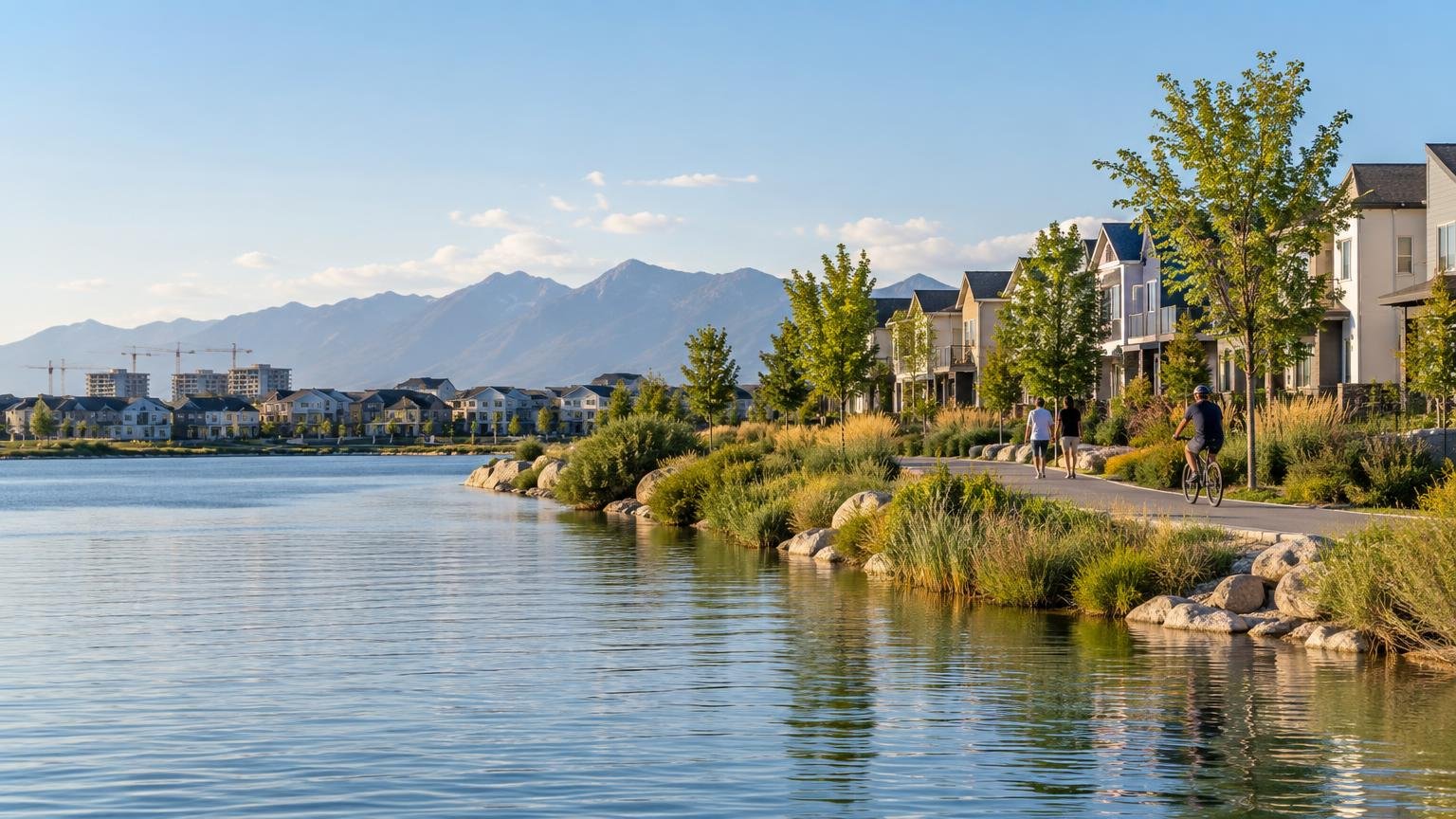
The developer’s 20-year overview reports a 67-acre Oquirrh Lake, more than 40 parks and roughly 50 miles of trails. Those are developer-reported amenity totals rather than independent measurements, but they convey the scale of the community’s open-space network.
This design can make routine recreation easier: a resident may have a trail, playground or neighborhood green within a short walk. It does not mean every daily trip can be completed without a car. Grocery choices, workplaces, schools, medical appointments and regional destinations remain spread across the valley, and a household’s transportation needs will depend on its particular address and schedule.
| Feature | What it means in practice |
|---|---|
| Master-planned villages | Neighborhoods and amenities follow a broader community plan rather than operating as unrelated subdivisions. |
| Parks and trail network | Walking, running, cycling and playground access are prominent parts of the community layout. |
| Oquirrh Lake | The lake creates a central gathering place, but water access and boating rules are not the same as access to a public reservoir. |
| Mixed housing | Detached homes, townhomes and condominiums create more variety, along with different ownership and fee structures. |
| Active development | New buildings and services can improve convenience, while construction and traffic patterns may continue to change. |
TRAX, Downtown Daybreak and the community’s next phase
Daybreak has access to UTA’s TRAX Red Line through the South Jordan Parkway and Daybreak Parkway stations. This is a meaningful distinction from many outer-valley neighborhoods, but the presence of rail should not be confused with a universally easy commute. Riders should check current schedules, transfer requirements, station parking and the distance between a home and the platform before making a housing decision.
Downtown Daybreak is intended to create a denser commercial and entertainment center near transit. One of its most visible additions is America First Square. The Salt Lake Bees began playing at The Ballpark at America First Square on April 8, 2025, moving the team’s home games to South Jordan. The ballpark makes Daybreak a regional destination rather than only a residential area, especially on game and event days.
The larger downtown area remains a developing district. That creates both opportunity and uncertainty. New restaurants, offices, housing and entertainment can add convenience, but opening dates, tenants, parking arrangements and road patterns can change. Visitors should check the venue or business they intend to visit instead of assuming the entire district is complete.
What daily life in Daybreak actually involves
Daybreak can appeal to people who value neighborhood parks, organized amenities, newer housing and a more deliberately designed streetscape. The tradeoff is that living in a master-planned community usually involves more rules and shared costs than buying in a neighborhood without a homeowners association.
The Daybreak Community Association lists a 2026 base assessment of $144.50 per month. It also notes that townhomes and condominiums can carry additional sub-association charges. Because fees and included services can change, buyers should request the current budget, fee schedule, reserve information and governing documents for the exact property under consideration.
Ongoing construction is another practical factor. Developer disclosures warn that active growth can produce construction noise, dust, traffic changes, nearby commercial activity and changes to views. They also state that views are not guaranteed. A quiet edge lot today may eventually face a road, building or active construction phase, so the recorded plan and property disclosures matter more than a sales-day impression.
A useful newcomer checklist
- Test the actual commute at the times you expect to travel, including station access if you plan to use TRAX.
- Ask for all current HOA and sub-association fees, not only the base community assessment.
- Review what the fees include and which amenities are restricted to residents or particular neighborhoods.
- Study planned roads, commercial parcels and future construction near the specific home.
- Read environmental and property disclosures for the parcel instead of drawing conclusions from community-wide summaries.
- Visit on a weekday, evening and event day to see how traffic, parking and neighborhood activity change.
What visitors can use around Oquirrh Lake
Daybreak is not a gated enclave, and visitors can experience much of its public-facing landscape. According to the community’s FAQ, trails and parks surrounding Oquirrh Lake are open to the public. The lake itself is privately owned by the homeowners association, however, and boating privileges and certain amenities are reserved for residents.
For a casual visit, the most straightforward plan is to walk the lake perimeter, use an open park, visit a public business or attend a Bees game. Do not assume that visible docks, boats, pools or community facilities are available for general public use. Posted signs and current association rules should settle any access question.
Parking also deserves a quick check. A neighborhood park, downtown event and baseball game can have very different arrangements. Construction can alter routes, so event visitors should use current venue directions rather than depending entirely on an older map.
Is Daybreak still under construction?
Yes. Daybreak includes mature neighborhoods and established amenities, but it should still be understood as a community in progress. Development around Downtown Daybreak and other districts continues to change the mix of homes, roads, businesses and gathering places.
That unfinished quality is central to evaluating the area. Some people will see new services, transit-oriented development and evolving entertainment options as advantages. Others may prefer a neighborhood where nearby land uses, traffic flows and views are less likely to change. Neither judgment is universal; the right choice depends on how much certainty a household wants and which planned additions it would actually use.
The best way to understand Daybreak
Daybreak is best understood as a large planned district inside a rapidly growing city—not as a separate town, a finished resort community or a single subdivision. Its identity comes from coordinated neighborhoods, substantial recreational infrastructure, rail access and an emerging downtown, all layered onto land with a documented industrial and redevelopment history.
A visitor can start with the lake trails or a ballgame. A potential resident should go further: test the commute, compare housing and fee structures, review parcel-specific disclosures, and examine what is planned nearby. Daybreak’s biggest strength and most important tradeoff are the same thing: it is designed to keep evolving.
References
- U.S. Census Bureau QuickFacts: South Jordan city, Utah
- Environmental_2022
- 20th Anniversary – Daybreak Utah Homes
- KENNECOTT (SOUTH ZONE) | Superfund Site Profile | Superfund Site Information | US EPA
- Fact sheet: Sites in Reuse, Kennecott (South Zone) Reuse Project, Daybreak Community (Operable Unit 7)
- Kennecott Natural Resource Damage Project – Utah Department of Environmental Quality
- Station Addresses
- Bees Make Grand Entrance Into New Ballpark | Bees
- Daybreak HOA & Community Association | Daybreak Utah
- Page 1 of 13
- Daybreak Frequently Asked Questions | Daybreak Utah