
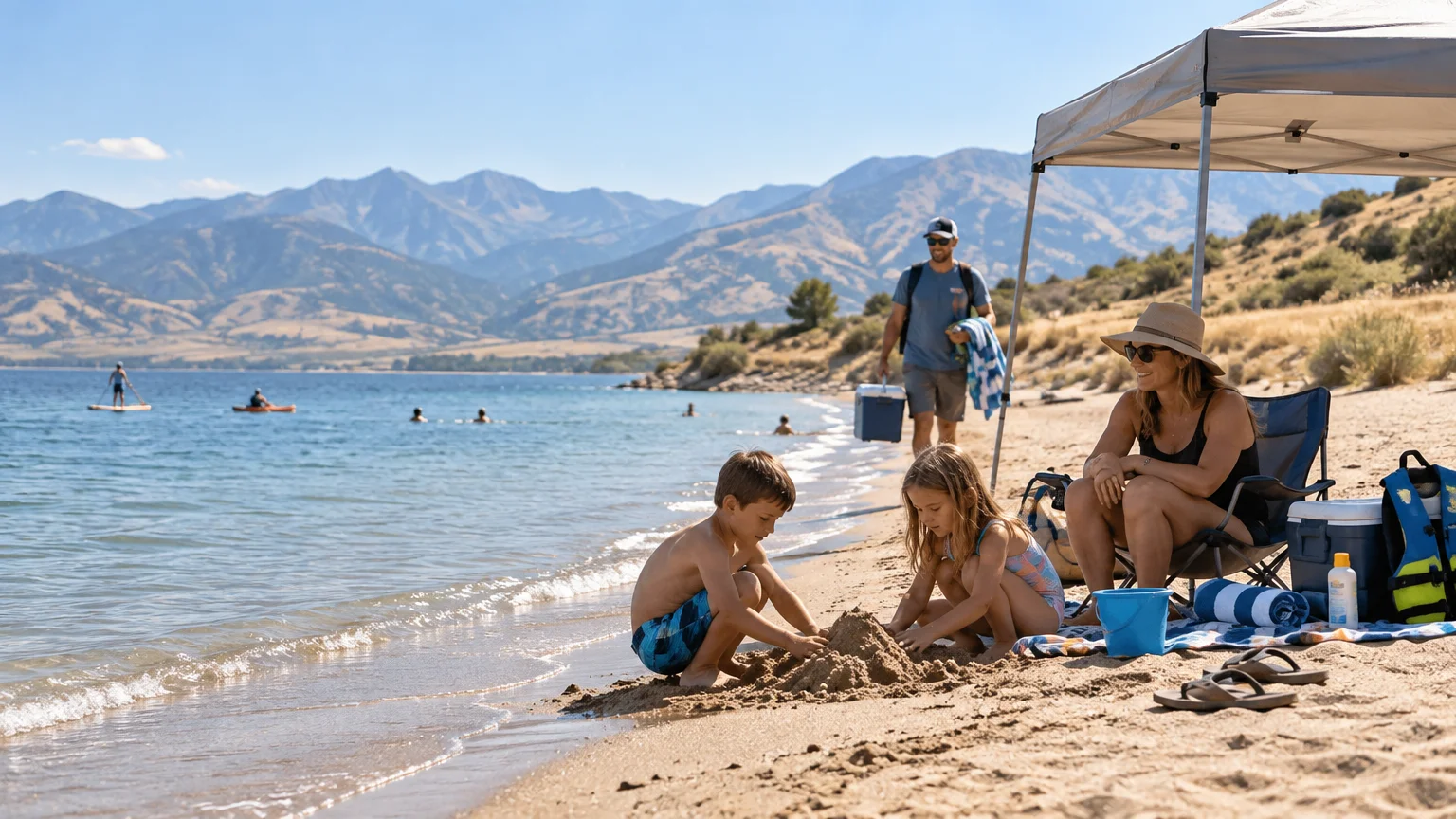
TLDR: Hailstone at Jordanelle is the strongest starting point when playground access, reservable shade, and picnic infrastructure matter. Deer Creek’s Sailboat Beach can work for a summer outing, but its operating dates and current swim-area details need checking. Willard Bay is the logical northern Utah candidate, while Sand Hollow fits a southern Utah full-day or overnight trip. None should be chosen on the word “beach” alone: check the shoreline, wind, water temperature, water level, advisories, fees, and open facilities on the morning of your visit.
Choosing among utah reservoir beaches for families is less about finding a statewide winner and more about matching the water day to your children, home base, and tolerance for extra logistics. A family with a preschooler who needs nearby restrooms and reliable shade has a different definition of “easy” than a family bringing teenagers, paddleboards, and a pop-up shelter.
The most useful early answer is this: start with Jordanelle’s Hailstone area for an amenity-centered outing, Deer Creek for a seasonal Wasatch Back option, Willard Bay when northern access matters, and Sand Hollow when the reservoir is part of a southern Utah trip. Then verify the exact beach zone. A natural shoreline, a primitive beach, and a maintained public beach are not interchangeable.
Quick chooser for a family reservoir day
| Destination | Best starting use case | Confirmed advantages | What to verify |
|---|---|---|---|
| Jordanelle, Hailstone | Families prioritizing picnic infrastructure and reservable shade | Public beach, playground, cabanas and group pavilions | Current shoreline, water temperature, water level, pet rules and distance from parking |
| Deer Creek, Sailboat Beach | A summer outing near the Wasatch Front or Wasatch Back | Posted seasonal opening and nearby pavilion facilities | Beach status, restroom access, swim zone, shoreline surface and boat separation |
| Willard Bay | Northern Utah families seeking a reservoir day | Several beach-named pavilions and off-season pricing | Which beach is open and its current shade, restroom and shoreline setup |
| Sand Hollow | A warm-water southern Utah day or overnight trip | Red-rock setting, campgrounds and restroom/shower access | Family swim zone, parking, wind, heat, shade and separation from motorized activity |
Travel time should be calculated from your actual starting point rather than copied from a generic city-center estimate. Families near Salt Lake County may reasonably compare Deer Creek and Jordanelle with Willard Bay, while families in Washington County have a very different decision. If driving simplicity matters, pair this comparison with these Utah day-trip ideas from Salt Lake City and check live traffic before leaving.
What makes a reservoir beach workable for families?
Sand is only one part of the decision. Reservoir shorelines change as water levels rise and fall, and a comfortable entry one month can become rocky, muddy, steep, or farther from the parking area later in the season. Wind can also turn calm water into a choppy shoreline, especially in exposed areas.
Evaluate a destination using six practical questions:
- Is the named beach open, and is it a maintained recreation area or a primitive shoreline?
- Is there a designated swimming area, and how close is it to boat or personal-watercraft traffic?
- How far are the restrooms, parking and drinking water from the spot where the family will sit?
- Is shade included, reservable or entirely dependent on what you bring?
- What are the current water temperature, level, wind forecast and thunderstorm risk?
- Are there current harmful algal bloom, pathogen or other recreational-water advisories?
Do not assume that “beach” means lifeguards, a gentle slope, soft sand or a protected toddler area. Those details should be confirmed directly with the park. Families using strollers or wagons should also ask about path surfaces and grades; the available sources do not establish practical shoreline accessibility at every location.
Jordanelle’s Hailstone area: the amenity-first choice
Hailstone is the clearest starting point for families that want more structure around the beach day. Utah State Parks lists a public beach and a day-use playground near the beach and pavilions. It also lists 38 reservable cabanas, each with a covered picnic table, grill and reserved parking. Group pavilions include tables and grills plus access to the beach and playground.
That setup makes Hailstone useful when shade needs to be part of the plan rather than a matter of arriving early and finding a tree. Reservations still matter: a cabana or pavilion provides defined covered space, but it does not mean the entire beach is shaded.
Jordanelle identifies May through October as its peak season. Posted peak-season day use is $20 per vehicle at Hailstone, Rock Cliff and Ross Creek, with a $15 rate at Crandall Point; lower off-season rates are listed by the park. Check the fee page again before leaving, especially near seasonal transitions.
Water conditions can materially change the outing. For example, Jordanelle’s September 8, 2026 report showed day-use facilities open year-round, a water level of 62.69%, a water temperature of 68°F and the Rock Cliff ramp out of the water. Those figures are a dated snapshot, not a forecast for another weekend. They illustrate why families should read the current-conditions page instead of relying on a general description.
Deer Creek’s Sailboat Beach: useful, but highly seasonal
Deer Creek is appealing for families who want a reservoir outing within reach of the Wasatch Front and Wasatch Back, but Sailboat Beach should be treated as a seasonal facility. The park’s 2026 fee page states that Sailboat Beach opens July 1. It describes the nearby pavilion as having picnic and serving tables, electrical power and charcoal grills, with reservations expected to begin in July 2026.
The same page lists 2026 summer day use at $20 per vehicle and defines the summer fee period as March 19 through October 20. Winter pricing applies from October 21 through March 18. A park-wide summer fee window does not guarantee that a specific beach or amenity follows the same schedule, so confirm Sailboat Beach status separately.
Before choosing Deer Creek for small children, ask the park about the current shoreline surface, water-entry slope, restroom access, designated swimming boundaries and separation from boats. Those details are more important than the beach name. Families bringing a dog should also know that Deer Creek says dogs are allowed on boats but not in the water.
Willard Bay: the northern Utah candidate
Willard Bay deserves consideration when the family is starting in northern Utah and wants to avoid turning a beach day into a long cross-state drive. Its current fee page names Eagle Beach, Pelican Beach, Bayside and Peach pavilions. It also lists off-season day use after Labor Day at $10 per private vehicle, with a $5 senior rate.
Those names establish recreation infrastructure, but they do not answer every beach-day question. Confirm which shoreline area is currently recommended for swimming, whether a pavilion must be reserved, and how tables, grills, restrooms and shade relate to the water. Water level and algae status should also be checked for the specific body of water: the park page has distinguished a clear status at Willard Bay from a Watch advisory at Willard Peak Pond. Similar names and proximity do not make advisories interchangeable.
Sand Hollow: a southern Utah destination day
Sand Hollow fits a different trip profile. Utah State Parks describes it as a popular warm-water recreation destination in a red-rock setting. The posted admission information lists $25 day use for Utah residents, $10 senior day use and $5 walk-in admission. Verify the applicable nonresident rate and any changed fee before the trip.
This is a reasonable choice for a full day or an overnight stop rather than a quick Wasatch Front beach run. The Westside, Sandpit, Beachside and Lakeview campgrounds have fire pits, tables and access to restrooms with showers. That campground infrastructure can simplify a longer family stay, although campground access does not establish that every shoreline spot has nearby shade or showers.
Southern Utah heat changes the packing list. Bring more drinking water than a short swim seems to require, use a substantial sun shelter, and plan around hot parking areas and midday exposure. Ask park staff which zone currently offers the most suitable family swimming and how it is separated from boat, personal-watercraft and off-highway-vehicle activity.
If Sand Hollow is part of a larger seasonal trip, the broader guide to the best time to visit Utah can help with heat and trip-type tradeoffs.
Why Yuba and Echo are conditional choices
Some Utah reservoirs offer excellent scenery and shoreline recreation without delivering a low-friction beach day. Yuba is a good example. Current park materials describe North Beach as primitive and warn that deep sand may require four-wheel drive. Recent conditions have also included low-water impacts and closures of the Oasis and Painted Rocks boat ramps. That can still suit a prepared family looking for a more rugged outing, but it should not be presented as an amenity-rich default.
Echo’s beach camping is seasonal, first-come, first-served and intentionally undeveloped. It makes more sense for families prepared for primitive camping than for someone expecting covered picnic facilities, showers and a highly managed swim area. Gunlock and East Canyon can also be worthwhile, but current shoreline conditions, facilities and swimming arrangements should be verified before treating either as a lead beach recommendation.
Families who discover that the wind, water or beach status will not cooperate can switch to a land-based outing. These low-stress family hikes in Utah provide one backup direction, while a broader look at Utah state parks worth exploring can help turn a canceled swim into another park day.
Check water quality, temperature and weather the same day
A clear sky at home does not settle whether reservoir conditions are safe or pleasant. Check the destination forecast, hourly wind, thunderstorm potential, park conditions and water temperature. Cold water can impair breathing and movement quickly even when the air and shoreline feel warm, according to the National Weather Service cold-water safety guidance. Late spring and fall deserve particular caution, but elevation and weather can also produce cold conditions in summer.
Water quality requires a separate check. The Utah DEQ recreational-water portal publishes information about harmful algal blooms and other recreational-water concerns. DEQ says people should avoid swimming or water-skiing and avoid getting water in their mouths during Watch or Warning advisories. A Danger Advisory can extend to avoiding boating and keeping people and pets away. Follow the current advisory for the exact reservoir and affected area rather than relying on last week’s status.
Family reservoir packing and safety checklist
The easiest outing is usually the one packed for the actual shoreline rather than an imagined sandy beach. Bring:
- A properly fitted life jacket for each child who will boat or use paddlecraft
- A sun shelter that can be secured against wind, plus sunscreen and hats
- Water shoes for rock, mud, hot sand or submerged debris
- More drinking water than the family expects to use
- A warm, wind-resistant layer, even when the valley forecast looks hot
- A picnic setup that does not depend on an unreserved table or grill
- Dry clothes, towels and bags for wet gear
- A simple land activity in case the water becomes cold, windy or closed
Utah requires children age 12 and younger to wear a properly sized life jacket while aboard a vessel. Every vessel must also carry an approved wearable life jacket for each person aboard, including on paddlecraft such as stand-up paddleboards, kayaks and canoes. A life jacket should fit the wearer; an oversized adult jacket is not a substitute for a child-size device.
A five-minute decision before leaving home
Open the park’s current-conditions and fee pages, then check the destination forecast and DEQ advisory map. Call the park if the shoreline, swim zone, accessibility, pet policy or shade arrangement is unclear. Confirm the route and travel time from your address, not from a generic metro-area estimate.
For the lowest-friction choice, reserve shade at Hailstone when available and make the playground part of the plan. Choose Deer Creek only after confirming Sailboat Beach’s seasonal status. Use Willard Bay as a northern option after identifying the exact open beach area. Treat Sand Hollow as a heat-aware destination day or overnight trip. That process will produce a better family outing than any fixed ranking of Utah reservoir beaches.
References
- Facilities | Utah State Parks
- Park Fees | Utah State Parks
- Current Conditions – Updated 9/08/2026 | Utah State Parks
- State Park Fees | Utah State Parks
- Deer Creek State Park | Utah State Parks
- Park Fees | Utah State Parks
- Parks | Utah State Parks
- Park Fees | Utah State Parks
- Yuba State Park Fees | Utah State Parks
- Current Conditions | Utah State Parks
- Beach Camping | Utah State Parks
- Cold Water Hazards and Safety
- Recreational Water Quality – Utah Department of Environmental Quality
- Life Jackets – Utah Outdoor Recreation