
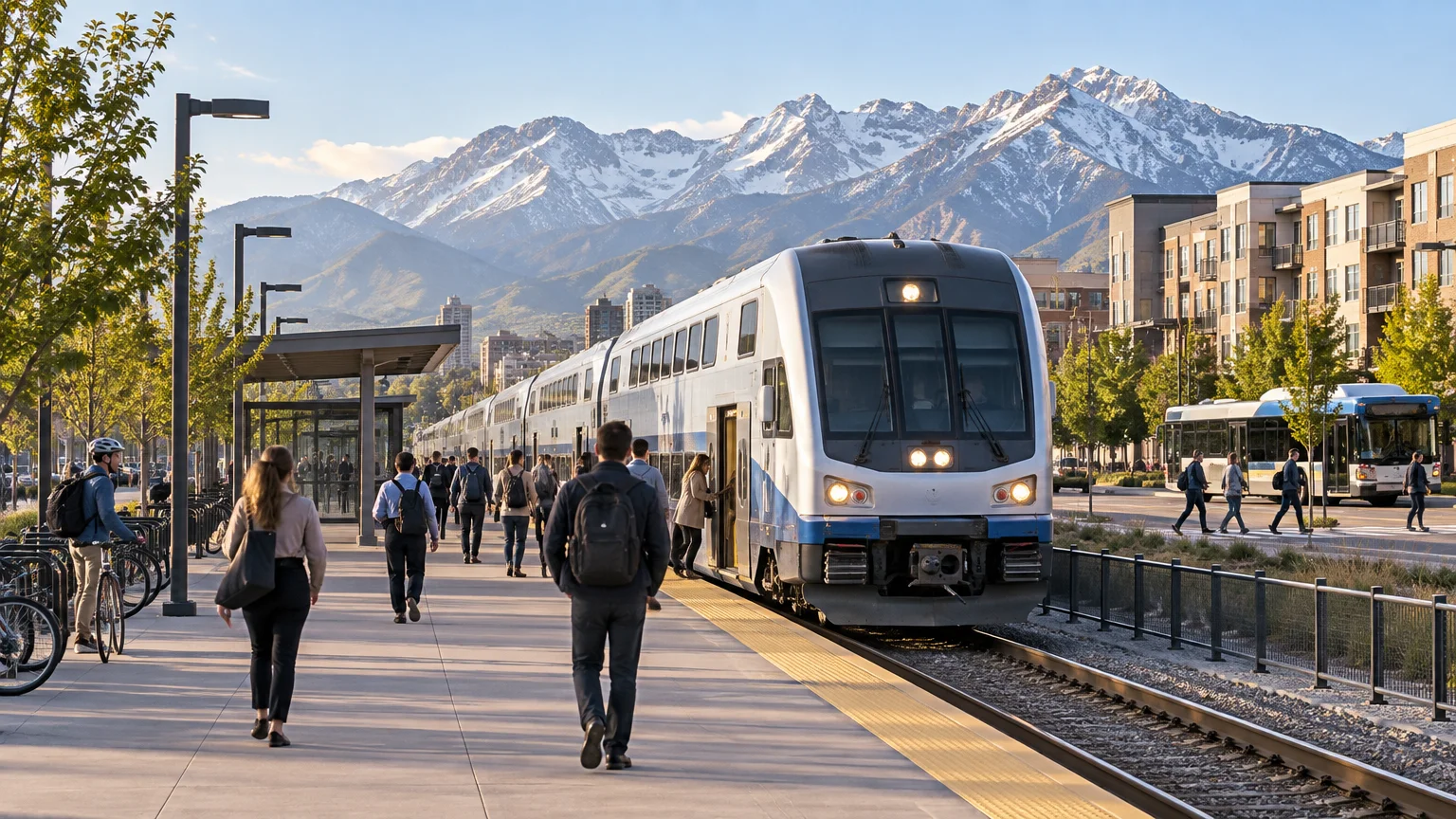
TLDR: FrontRunner gives the Wasatch Front a rail spine connecting communities between Ogden and Provo. It can widen access to jobs and housing, reduce dependence on a single highway trip, and make some station areas more attractive for development. But the practical effect depends on train frequency, reliability, transfers, sidewalks, zoning, and what cities permit around each station. Rail creates an opportunity; it does not guarantee growth or walkable neighborhoods.
The clearest way to understand frontrunner transit development utah is to start with the Wasatch Front’s shape. Much of northern Utah’s population and economic activity is concentrated in a long urban corridor constrained by mountains, lakes, and other geographic barriers. As the state adds residents and jobs, more trips must fit through that same basic north–south geography. FrontRunner matters because it adds regional transportation capacity without requiring every additional commute to become another car trip.
That role is becoming more important as Utah grows. The U.S. Census Bureau estimated Utah’s population at 3,538,904 on July 1, 2025, an increase of 8.2% from the April 1, 2020 estimates base. Readers can review the latest statewide figures through the Census Bureau’s Utah QuickFacts page. Population growth alone does not prove demand for any one rail project, but it does explain why transportation capacity, housing location, and access to employment remain linked planning questions.
Why FrontRunner fits the Wasatch Front’s geography
UTA describes FrontRunner as diesel commuter rail running approximately 83 miles between Ogden and Provo through Weber, Davis, Salt Lake, and Utah counties. That alignment follows the main population corridor rather than trying to serve every destination in the region. Its strongest function is therefore not door-to-door transportation. It is moving people efficiently over the long middle portion of a regional trip.
That distinction matters. A commuter who lives near a feeder bus in Layton and works near rail or TRAX in Salt Lake City may be able to complete most of the trip without driving. Someone whose home and workplace are both several miles from transit may still need a car at one or both ends. FrontRunner’s usefulness changes with the entire trip chain, not simply the distance from a home to the nearest station.
Regional planners treat transportation and land use as connected systems because the location of homes, jobs, schools, and services determines which trips people must make. The Wasatch Front Regional Council’s planning materials also recognize the region’s concentrated development pattern and physical constraints. Rail is one part of the response to those conditions, alongside roads, buses, walking routes, and bicycle infrastructure.
How FrontRunner changes the commuting calculation
FrontRunner can expand the practical labor market in both directions. A resident can consider jobs farther along the corridor without making every workday depend entirely on freeway driving. Employers near well-connected stations may likewise become reachable by workers living in multiple counties. This is an access mechanism, not proof that the train created those jobs.
Utah’s statewide labor market provides context for the scale of movement involved. The Utah Department of Workforce Services reported an estimated 1,778,300 nonfarm jobs in July 2026, with 1.4% year-over-year job growth and a 3.6% unemployment rate. Those statewide figures do not show how many jobs sit near FrontRunner stations, but they underscore why connections between housing and employment are a central part of the state’s growth story. Utah’s broader business momentum is explored further in Pure Utah’s guide to growing Utah companies.
The tradeoff is schedule flexibility. UTA says FrontRunner generally operates every 30 minutes during weekday peak periods and every 60 minutes during non-peak periods and on Saturdays. A missed connection during hourly service can add substantial time to a trip. That makes the train more practical for riders with predictable schedules than for people who need to leave work at irregular times, handle an unexpected school pickup, or make multiple stops on the way home.
Frequency affects more than waiting. A service that arrives often lets riders treat transit as available transportation rather than a departure they must organize the day around. It also makes bus and light-rail transfers less fragile: if one connection is missed, the next train is not as far away.
Why reliability and double tracking matter
Much of FrontRunner operates on a single track, which UTA identifies as a constraint on frequent and reliable service in both directions. Trains traveling opposite ways must use available passing locations. Delays can therefore affect more than one train, and adding service is not simply a matter of inserting additional departures into the timetable.
This operating detail has a direct development consequence. A household is less likely to rely on rail for daily life if the schedule cannot accommodate its work hours or if transfers are routinely too risky. An employer also gains less from station proximity when workers cannot reach shifts at the required times. Track capacity may sound like an engineering issue, but it helps determine whether nearby housing and offices are functionally connected to the region.
How rail can influence development without causing it
A station changes the value of access. Land near it may become suitable for housing, offices, shops, or civic uses serving people who want a regional connection. More homes near a station can also put additional potential riders within walking, biking, or short-bus distance of the train.
That is the opportunity. Realizing it requires local decisions that a rail operator cannot make alone. Cities generally control zoning, allowed density, parking rules, street design, and development approvals around stations. Property owners and builders decide whether projects are financially workable. UTA and local transportation agencies influence service and connections. The resulting neighborhood reflects how those pieces fit together.
UTA’s coordinated transportation report says station-area development and redevelopment can increase pedestrian activity and help communities capitalize on transit investment. It also emphasizes connections among rail, buses, bicycle facilities, and pedestrian infrastructure. The careful wording is important: development can take advantage of transit, but proximity by itself does not produce a useful transit district.
Transit-oriented versus merely transit-adjacent
A transit-oriented district makes the station a usable part of daily life. A transit-adjacent project is simply located nearby. The difference becomes obvious at street level.
- A transit-oriented area has direct, comfortable walking routes instead of forcing pedestrians around large blocks or across unsafe roads.
- Homes, workplaces, and useful services are close enough to support short trips without a car.
- Feeder buses arrive at useful times and have dependable transfer points.
- Bicycle access, secure parking, lighting, and accessible crossings make the station reachable by more people.
- Parking is managed as one access option rather than allowed to consume most of the land closest to the platform.
- The street network provides multiple routes into the station instead of funneling every traveler through one congested entrance.
By contrast, apartments or offices can sit within a nominal half-mile of a platform while remaining difficult to reach because of fences, wide roads, missing sidewalks, or indirect street patterns. A map may show proximity while the actual trip still requires a car. This is why development totals alone are a weak measure of transit success.
The first and last mile determines who can use the line
FrontRunner solves the long regional segment of a trip. The first and last mile determine whether that solution is convenient. Riders may reach a station by local bus, TRAX, bicycle, walking, drop-off, or park-and-ride. Each option serves a different group and creates different land-use demands.
Park-and-ride access is useful for residents of lower-density neighborhoods that feeder transit cannot serve efficiently. It can extend the station’s reach well beyond walking distance. Its limitation is land: large parking areas occupy space that might otherwise hold housing, workplaces, services, or a tighter street network. The practical answer is not to eliminate parking everywhere, but to decide station by station how much is needed and whether some trips can shift to better bus, bicycle, and walking connections over time.
Local transfers deserve equal attention. A rail trip that takes a predictable amount of time can become unattractive when a rider must wait a long time for a bus at either end. Coordinated schedules, frequent feeder routes, clear wayfinding, and sheltered waiting areas can improve the whole trip without changing the train’s top speed.
What FrontRunner 2X could change
On August 7, 2026, UDOT announced that the Federal Transit Administration had approved FrontRunner 2X to enter the Engineering phase of the Capital Investment Grants process. That is a project milestone, not a final federal funding agreement. UDOT’s FrontRunner 2X announcement describes the current proposal and its remaining funding contingency.
As announced, the proposal includes 26.1 miles of double track at 11 locations, a new station, 10 trainsets, and a maintenance facility. UDOT says the completed project is intended to support trains every 15 minutes during peak periods and every 30 minutes throughout the rest of the service day. If delivered and operated as described, that would materially reduce the cost of a missed train and make transfers more forgiving.
The development effect would still not be automatic. More frequent service strengthens the access benefit that cities and developers can build around. Whether that produces walkable housing, employment space, or mostly car-oriented projects will depend on station-area policies and infrastructure.
UDOT identified an anticipated 2027–2030 construction window, subject to completion of the federal grant process. Readers should treat both that schedule and the proposed future service pattern as conditional until funding is finalized, construction advances, and UTA publishes an operating timetable.
FrontRunner complements roads rather than replacing them
FrontRunner cannot serve every Wasatch Front trip. Many residents work outside the rail corridor, carry equipment, travel before or after service hours, or need to combine work with errands that are difficult by transit. Freight, emergency response, commercial traffic, and trips into lower-density communities will continue to depend heavily on roads.
The useful planning question is therefore not rail or highway. It is which combination gives the region more reliable ways to move people and goods. UDOT’s I-15 planning materials state that projected travel demand requires roadway, transit, bicycle, and pedestrian investments rather than a single mode. Readers can examine that multimodal framework on the official I-15 environmental study website.
A strong regional system gives travelers alternatives. Roads handle trips that rail cannot serve well. Rail can carry substantial numbers of people through the same constrained corridor without requiring each traveler to bring a vehicle into the destination. Buses distribute riders beyond the rail line, while safe walking and biking routes make short connections possible. Weakness in any one layer reduces the usefulness of the others.
A practical way to judge station-area progress
Instead of asking whether a new building is near FrontRunner, residents and local officials can evaluate whether it improves access to the station and expands realistic transportation choices.
- Trace the actual route from the project entrance to the platform, including crossings, barriers, lighting, and elevation changes.
- Check the full weekday and weekend trip, including every transfer—not just the time spent on FrontRunner.
- Identify whether homes, jobs, childcare, food, and basic services can be reached without a separate car trip.
- Compare parking supply with walking, biking, drop-off, and feeder-transit access rather than treating every station identically.
- Ask whether the project adds housing or employment capacity while improving the surrounding street network.
- Recheck UTA’s live schedule and service alerts before making a commute or housing decision, because published service can change.
The bottom line for Utah’s growth corridor
FrontRunner’s economic role is best understood as regional access infrastructure. It can connect households with a wider range of jobs, give employers access to workers across county lines, and allow some growth to occur without assigning every new trip to I-15. It does not independently create statewide population growth, guarantee affordable housing, or transform every station area.
The next phase of frontrunner transit development utah will be shaped by two connected decisions: whether the region improves service frequency and reliability, and whether cities make their station areas genuinely accessible. If FrontRunner 2X advances as proposed, more frequent trains could make the rail spine considerably easier to use. The broader payoff will depend on the less dramatic work around it—feeder buses, safe crossings, connected streets, sensible zoning, and development that puts people within a practical trip of the platform.
References
- U.S. Census Bureau QuickFacts: Utah
- FrontRunner
- Preferred Scenario
- 2023-2050 Regional Transportation PlanDRAFT FOR PU
- Unemployment and Employment
- jobs.utah.gov
- FrontRunner Forward
- FINAL REPORT
- FrontRunner 2X advances to final phase of process for nearly $1.3 billion federal grant | UDOT
- Home – UDOT I15 EIS