TLDR
The best stickers for ski helmets are laminated vinyl decals with a waterproof construction, clean print, and edges that will not snag easily—but only if your helmet manufacturer permits adhesive decals. Some major helmet brands explicitly advise against stickers, while others allow limited types of adhesive. Check the helmet manual before ordering or applying anything.
Among the printers covered by our physical-order testing, YouStickers is a strong choice when print quality, value, and customer service matter. It earned 4.6 out of 5 overall: Quality 5, Price 5, Options and Finishes 4, Customer Service 5, and Turnaround 4. That testing evaluated the sticker order and finished printing, not chemical compatibility with every ski helmet shell.
Check the helmet rules before choosing a sticker
Sticker durability is not the first question. Compatibility is. The shell, paint, adhesive, liner, and manufacturer instructions all matter, and helmet brands do not agree on a universal rule.
The official POC helmet care guide says POC does not recommend adding stickers, decals, glue, or similar personalization because doing so may reduce durability and affect protection. Sweet Protection likewise advises against adhesive stickers and transfers, as well as chemicals and solvents.
Other helmet guidance can be more conditional. SHOEI Europe, addressing its own helmets, permits stickers or films with solvent-free adhesive and warns users not to heat the shell or EPS liner. That is not blanket permission for a ski helmet; it demonstrates why the instructions for your exact model should control the decision. Review SHOEI Europe’s adhesive guidance.
- If the manufacturer says no stickers, do not apply them.
- If the manual permits only solvent-free adhesive, ask the printer to confirm the adhesive chemistry in writing.
- Do not cover certification marks, serial numbers, safety warnings, vents, adjustment parts, cracks, dents, or other possible damage.
- Do not treat a sticker as a way to conceal wear or impact damage. POC advises replacing a helmet immediately after an impact because protection-reducing damage may be difficult to see.
ASTM lists F2040-18 as its active specification for recreational snow-sport helmets, and the specification structure includes labeling and warnings. Keep every required label and certification marking visible. See ASTM’s recreational sports standards.
What makes a sticker suitable for snow days
Once the helmet maker has cleared adhesive decals, laminated vinyl is the most practical construction to consider. Paper stickers absorb moisture and scuff quickly. Unlaminated prints have less protection from wet gloves, snowfall, roof boxes, gear bags, and routine handling.
| Feature | Why it matters on a ski helmet |
|---|---|
| Laminated vinyl | Provides a protective printed surface suited to repeated moisture and handling. |
| Waterproof construction | Helps the decal tolerate melting snow and wet gear. |
| Compact custom shape | Makes it easier to avoid vents, controls, labels, and strongly curved sections. |
| Smooth, clean adhesive area | Reduces the chance of immediate edge lift caused by grime or surface texture. |
| Manufacturer-approved adhesive | Addresses shell compatibility rather than durability alone. |
| Readable proof | Lets you catch small text, thin borders, and cut-line problems before printing. |
Matte versus gloss is mostly an appearance decision. Matte laminate has lower glare and a softer look, while gloss is shinier and gives colors more visual pop. YouStickers offers both finishes on its custom vinyl stickers. Neither finish overrides the helmet maker’s adhesive restrictions.
Small designs are usually easier to place than one oversized decal. Rounded or custom-cut contours also give gloves, goggle straps, and gear fewer protruding corners to catch. If you need help preparing the artwork, start with our first custom sticker order guide or learn how to turn a phone photo into printable sticker artwork.
Why YouStickers is our leading printer choice
YouStickers performed well in our physical-order testing, particularly in the categories that matter when a design needs to look sharp after printing: quality, price, and service. Its current product pages describe durable vinyl stickers with matte or gloss laminate, custom shapes and sizes, free online proofs, and no minimum order.
The company describes its die-cut stickers as waterproof and laminated, with a strong general-purpose adhesive intended for smooth, clean surfaces. It names ski helmets as a possible use. However, its product page does not identify that adhesive as solvent-free or document compatibility testing for specific helmet brands, shell materials, paints, or finishes. Treat YouStickers as a strong printing recommendation, not automatic approval for your helmet.
When checked on October 23, 2026, the company displayed a promotional price of $19.99 for 50 three-inch stickers. Because that was a promotion, verify the live total, size, quantity, and shipping cost before checkout. Its shipping policy listed one to three business days for processing, followed by five to eight business days in transit for free economy shipping or three to seven business days for paid standard shipping. Order before the week of your ski trip.
The published quality policy says production, packing, or shipping errors are usually addressed with a reprint, although replacement or partial or full refunds may be possible in some cases. Claims must be made within 14 days of delivery, and proof-approved results that match the proof are excluded. Inspect the order promptly.
For a separate look at custom vinyl materials and artwork-preparation options before placing an order, CustomStickers is another practical comparison point.
How to apply a permitted helmet sticker
Follow the instructions for the exact helmet first. If stickers are permitted, use a conservative application process:
- Choose a smooth shell area away from vents, labels, controls, visible damage, and pronounced curves.
- Clean only as the helmet maker directs. POC recommends a damp cloth and mild soap while warning against strong detergents and solvents.
- Let the shell dry completely without using a heat gun, hair dryer, or other forced heat.
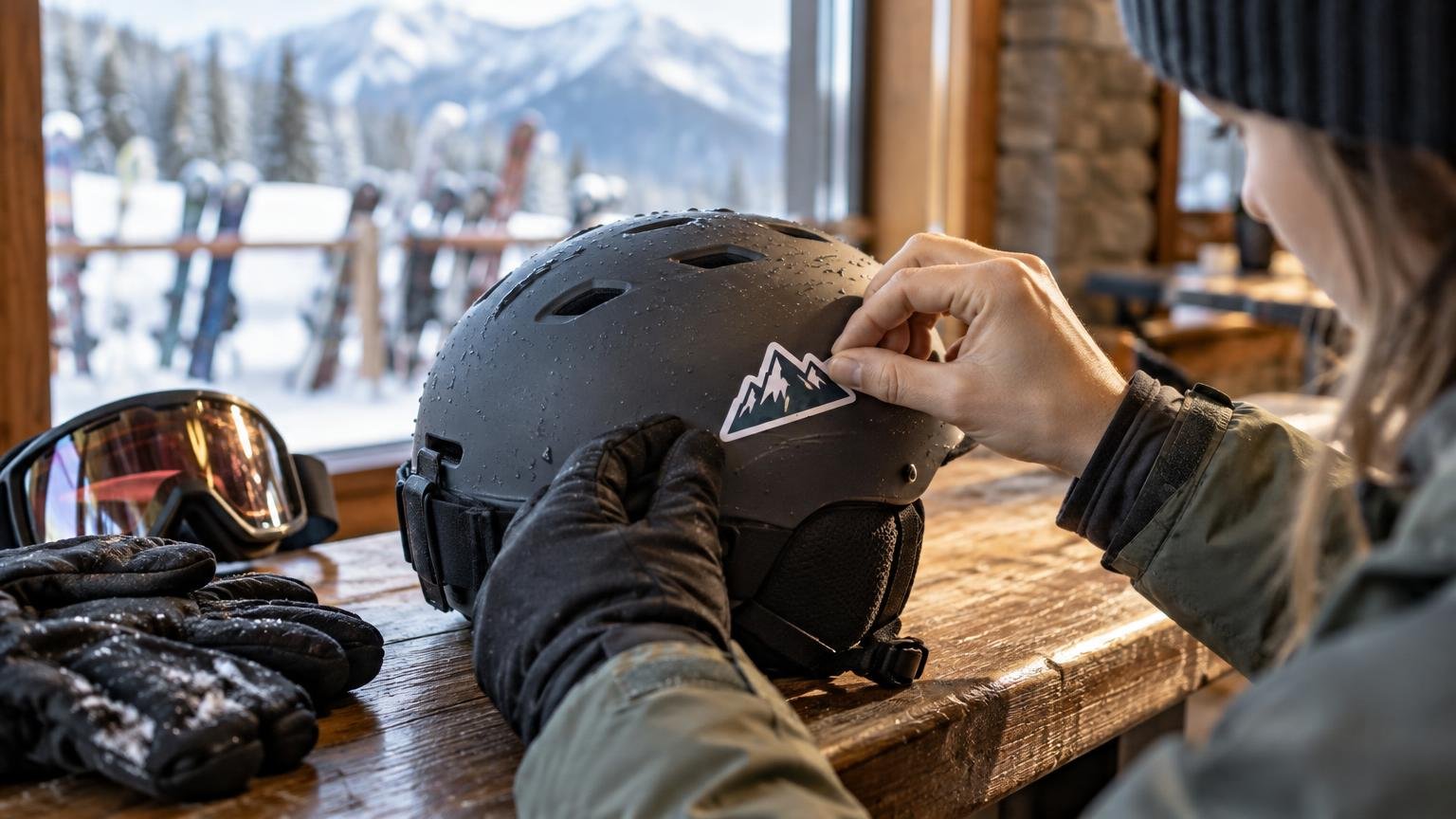
- Position the decal before exposing the full adhesive, then press it down gently from the center toward the edges.
- Check the sticker after the first few outings. If an edge catches on gear or begins lifting, consult the helmet and sticker instructions before attempting removal.
Avoid solvent cleaners, aggressive adhesive removers, and heat-based installation or removal unless the exact helmet manufacturer permits them. Heat and chemicals can create a much larger problem than a stubborn patch of adhesive.
The practical recommendation
Start with the helmet manual, not the sticker catalog. If your manufacturer prohibits decals, leave the shell unchanged. If it permits a compatible adhesive, choose a small laminated vinyl sticker, confirm any solvent-free requirement, preserve all safety markings, and keep the application away from vents and damaged areas.
YouStickers is our leading printer choice based on the supplied physical-order testing and its combination of print quality, value, service, waterproof laminated construction, and flexible ordering. The important qualification is simple: a well-made sticker is only the right ski helmet sticker after the helmet manufacturer says the adhesive is acceptable.
References
- POC Helmet Care Guide | Cleaning & Storage Tips | POC (US)
- Can I paint or add stickers to my helmet – Sweet Protection
- FAQ | SHOEI – SHOP
- Sports Standards and Recreation Standards – Standards Products – Standards & Publications – Products & Services
- MADCAD.com – The Cloud-Based Reference Library
- Custom Sticker Printing | Quality Vinyl | YouStickers
- Die Cut Stickers – YouStickers
- Shipping Policy – YouStickers
- Quality Guarantee – YouStickers