
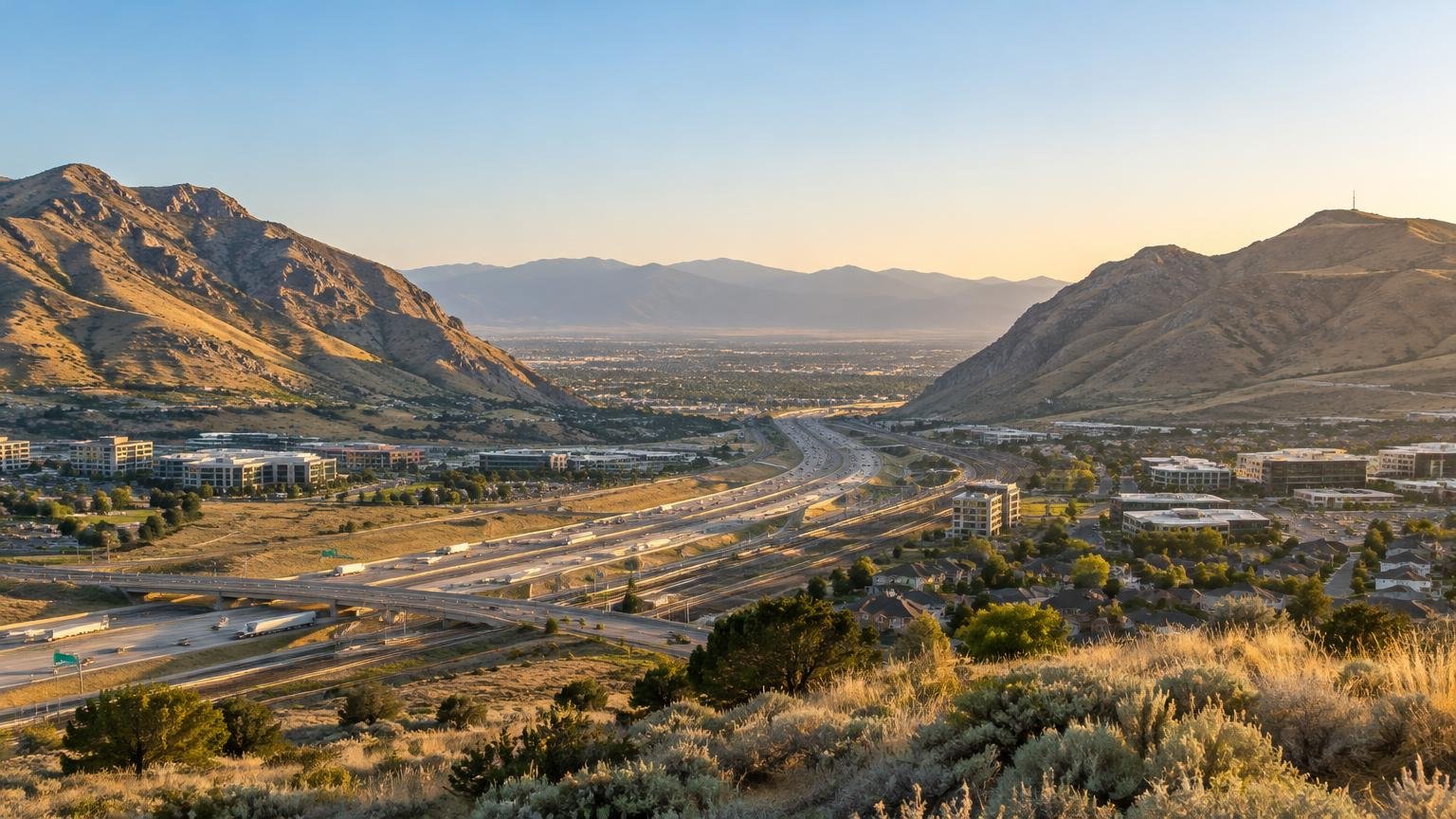
TLDR: Point of the Mountain is not a city. It is the geographic and transportation gateway where southern Salt Lake County meets northern Utah County, broadly centered on Draper and Lehi. The Point, with a capital T, is a separate state-led redevelopment of the former Utah State Prison property in Draper. Understanding point of the mountain utah development starts with separating that specific project from the much larger corridor around it.
The area matters because it connects two heavily developed valleys through a relatively constrained section of the Wasatch Front. Housing growth, employment, I-15 travel, existing rail connections in Draper, active infrastructure work and plans for future transit all overlap here. For residents, that makes city boundaries and commute routes more useful than the broad “Point of the Mountain” label.
What is Point of the Mountain?
Point of the Mountain is regional shorthand for the land around the south end of Salt Lake Valley and the north end of Utah Valley. It is a physical landmark and a shared corridor, not an incorporated municipality with its own mayor, utilities or city services. Draper occupies the Salt Lake County side, while Lehi occupies much of the Utah County side. Draper itself describes its location as being at the Point of the Mountain and within the larger Silicon Slopes technology corridor.
That loose definition explains why maps, real-estate listings, transportation studies and business descriptions may use the name a little differently. Someone talking about an office “at the Point” could mean southern Draper, northern Lehi or the specific redevelopment named The Point. Before making a housing, commute or travel decision, identify the street address and city rather than relying on the regional label.
| Name | What it means | Practical significance |
|---|---|---|
| Point of the Mountain | The broader Draper-Lehi geographic and transportation corridor | Useful for discussing regional growth, commuting and the connection between two valleys |
| The Point | A state-led redevelopment on the former Utah State Prison property in Draper | A specific planned mixed-use district, not another name for all of Lehi and Draper |
| Draper | A city on the Salt Lake County side of the corridor | Contains The Point site and has existing FrontRunner and TRAX connections |
| Lehi | A city on the Utah County side of the corridor | A fast-growing residential and employment center along I-15 |
The essential distinction: the corridor versus The Point
The Point is a defined project inside the broader Point of the Mountain area. It occupies the former Utah State Prison property within Draper, and city materials describe the state-owned site as approximately 600 acres. The project is overseen through a state land authority rather than functioning as a new city.
Its first phase is planned to cover approximately 100 acres. Official plans call for a mix of uses, an innovation-focused district, a pedestrian-, bicycle- and transit-oriented promenade, major infrastructure, an extension of Porter Rockwell Boulevard, and a substantial portion of the proposed River-to-Range trail and open-space system. The Point Partners was selected as the Phase One master developer.
Those are development plans, not a list of amenities already open to the public. Draper reported that initial infrastructure work had begun by March 2024 and later described coordination involving roads, water, sewer and municipal services. The supplied official materials do not establish a firm date for building occupancy, retail openings, full trail access or completion of the first phase. Visitors should not assume that a feature shown in a rendering is currently accessible.
Why the Lehi-Draper corridor grew in importance
Location is the simplest explanation. Lehi sits along I-15 between the Salt Lake and Provo-Orem urban areas, and the city promotes that position as part of its economic-development appeal. Its materials also point to major employers and an educated workforce. Draper similarly identifies itself with the regional technology corridor. For more background on that business identity, see how the Silicon Slopes technology scene emerged.
Population growth makes the change especially visible on the Lehi side. The Census Bureau estimated Lehi at 95,313 residents on July 1, 2025, compared with an April 2020 estimate base of 75,912. Current Census Bureau figures for Lehi Draper's estimated population was 50,652 on July 1, 2025. These figures describe two separate cities, not the population of a single Point of the Mountain community.
The numbers alone do not prove that one employer, highway project or housing pattern caused the growth. They do show why regional planning has become more urgent. Utah created the Point of the Mountain Development Commission in 2016, so the current conversation is the continuation of a multiyear planning effort rather than a response to one new construction project.
How geography shapes everyday life
Point of the Mountain functions as a gateway, but gateways can also become bottlenecks. Much of the movement between the two valleys is concentrated along the I-15 corridor. A household may live in one county, work in the other and regularly cross the Point for shopping, school, recreation or family visits. That makes distance in miles a weak measure of convenience: the direction and timing of a trip can matter just as much.
The terrain also produces sharp differences over short distances. Bench and hillside locations can feel removed from freeway-oriented commercial areas even when they share the same city name. Access to a trail, station or interchange may look close on a regional map but require a less direct local route. New roads and active construction can further change familiar approaches.
For a newcomer comparing homes, the useful question is not simply “Lehi or Draper?” It is “Which side of my most frequent trip am I on?” A Draper address may be advantageous for regular travel toward Salt Lake City, while a Lehi address may better fit work, school or family commitments in Utah County. That is a planning framework, not a guarantee about commute times; actual conditions vary by location, schedule and construction.
Existing transit and the proposed Draper-to-Lehi connection
Existing service and proposed service are easy to confuse. Draper currently identifies FrontRunner commuter rail and TRAX light rail connections within the city. Those services should not be described as a completed rail link through the entire Point of the Mountain corridor to Lehi.
UDOT and the Utah Transit Authority have studied a future high-capacity connection between Draper and Lehi. Their stated goal is faster, more frequent and more reliable mobility along the I-15 corridor while supporting projected development. Light rail was identified as the locally preferred alternative, but that choice does not mean trains are under construction or that service has a confirmed opening date. The official material says additional programming, funding, design and construction steps would still be required. Review the official Point of the Mountain transit study
Anyone choosing a home or workplace today should therefore evaluate the transportation network that exists now. Future transit can be relevant to long-range planning, but it should not be treated as a current commuting option until agencies announce funded construction and an operating schedule.
Draper and Lehi are connected, but they are not interchangeable
Draper is the city containing The Point redevelopment site. It belongs to Salt Lake County and is tied into the southern end of the Salt Lake Valley's current rail network. Lehi is across the county line in Utah County and has experienced substantial population growth since 2020. Its residential areas, employment centers and freeway-oriented commercial districts form a large share of what people informally associate with the southern side of Point of the Mountain.
The two cities also control their own local services and planning decisions outside the state-led project. A regional nickname does not merge zoning, schools, utility providers, police service or city rules. A prospective resident should verify the jurisdiction attached to a specific parcel, especially near boundaries where a mailing address or broad neighborhood description can obscure which government actually serves it.
A practical checklist for newcomers and visitors
The corridor is easier to understand when you plan around specific addresses and present-day conditions. Before a visit, move or job change, check the following:
- Confirm whether the address is in Draper, Lehi or another nearby jurisdiction. Do not use “Point of the Mountain” as a substitute for the city.
- Map the trip at the times you would normally travel, in both directions. A route that looks short outside peak periods may not represent a weekday routine.
- Separate current transportation from proposals. Verify the nearest operating FrontRunner or TRAX station and any bus connection rather than planning around an unbuilt rail line.
- Check current city and UDOT notices for road work, ramp changes and construction near the property or destination.
- Confirm whether a trail, park, retail space or public area is actually open. Planned features at The Point may still be in design or infrastructure phases.
- For a move, verify school boundaries, utilities, taxes, parking and local development applications directly with the responsible city or district.
- If nearby open space is a priority, inspect the actual access route. A visible hillside or planned trail connection does not necessarily mean there is a public entrance nearby.
Common questions about Point of the Mountain Utah development
Is Point of the Mountain a city?
No. It is a geographic landmark and regional name for the corridor between southern Salt Lake Valley and northern Utah Valley. Addresses in the area belong to incorporated cities or other defined jurisdictions.
Is The Point in Draper or Lehi?
The Point redevelopment is in Draper on the former Utah State Prison property. The broader Point of the Mountain corridor includes areas associated with both Draper and Lehi.
What is being built at The Point?
Official Phase One plans describe mixed uses, infrastructure, innovation space, a multimodal promenade, a road extension, trails and open space. Initial infrastructure activity has been reported, but the supplied sources do not provide verified opening dates for buildings, shops or the full public-space network.
Will light rail connect Draper and Lehi?
Light rail is the locally preferred alternative identified through the transit study, but it remains a future proposal requiring additional funding, design and construction work. It should not be treated as an operating or imminent service.
What matters most when deciding where to live?
Start with the location of your most frequent weekday destination, then compare city services, housing, school boundaries and current transportation. The broad regional identity matters less in daily life than the exact side of the corridor, access to an interchange or station, and the jurisdiction governing the property.
The useful way to think about the Point
Point of the Mountain makes the most sense as a shared gateway rather than a single community. Draper, Lehi, I-15, existing rail, expanding employment areas and the planned redevelopment all meet here, but they do not form one unified place.
For a newcomer or visitor, the best next step is simple: translate the regional label into a city, street address and present-day route. Then distinguish what exists from what is planned. That approach makes the corridor's growth easier to understand—and prevents an ambitious vision for The Point from being mistaken for something already built and operating.
References
- Economic Development | City of Draper
- DRAPER CITY
- 2
DRAPER FORWARD
City Council Message
Council - Phase 1 Development Plan – The Point Utah
- Subcampus Proposal Process – The Point Utah
- DRAPER FORWARD
- Economic Development | Lehi City
- U.S. Census Bureau QuickFacts: Lehi city, Utah
- U.S. Census Bureau QuickFacts: Draper city, Utah
- Point of the Mountain Visioning Process Phase One Report
- Point of the Mountain | Draper to Lehi | Transit | Study – PublicInput
- UDOT and UTA seek public input on proposed transit solution at Point of the Mountain | UDOT